Why is my PDF over 5MB?
A 6-page photo packet printed to PDF was 6,447,273 bytes. Re-encoding the pictures at the same 1870x2420 grid landed at 4,279,341, under the 5,000,000-byte portal cap.
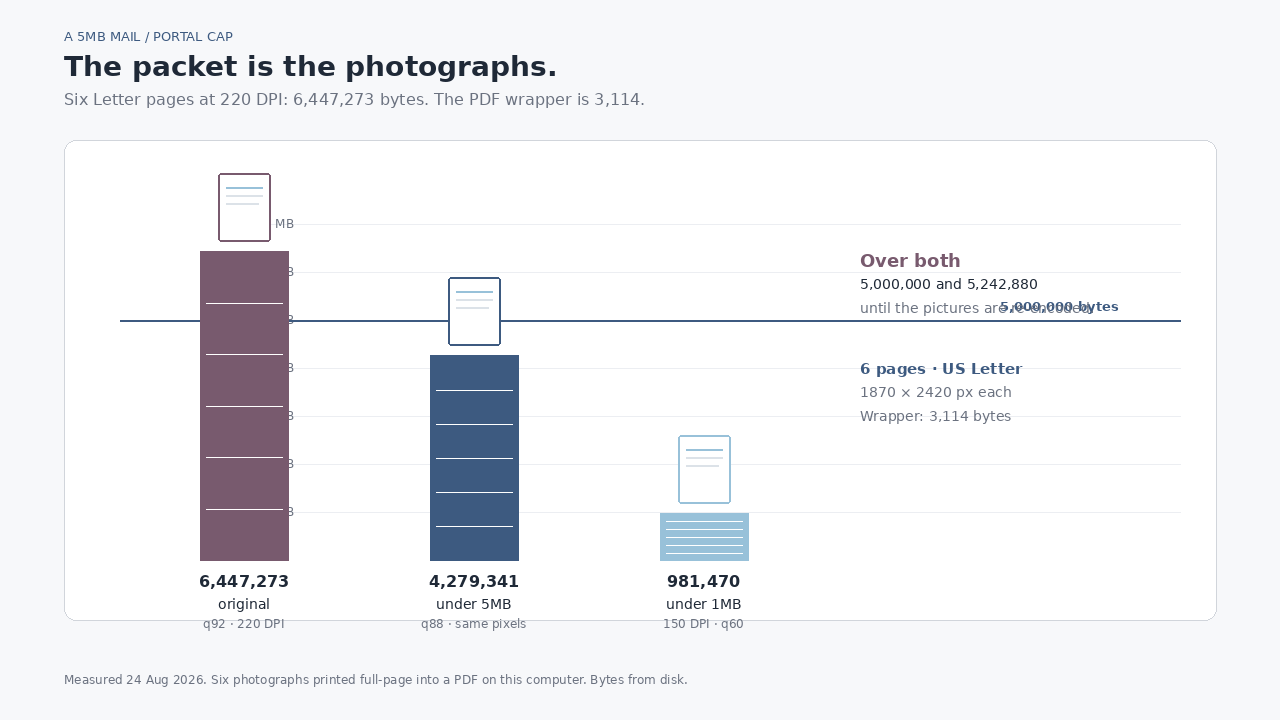
A six-page packet I printed on this computer is 6,447,273 bytes. That is 1,447,273 bytes over the 5,000,000-byte line many portals still treat as “5MB,” and 1,204,393 over 5,242,880 — five mebibytes. The PDF wrapper around those pages is 3,114 bytes. The file you cannot attach is the photographs.
Five megabytes is not the job-application cap. That one is 1MB, and it is a different argument. Five is the number that still sits on a lot of mail servers, client portals, and document-management upload forms: large enough that a written report never sees it, small enough that a scan packet sails past it. The form does not care that the pages are “only six.” It counts bytes.
What I actually printed
Six camera photographs, each fitted onto a US Letter canvas at 220 DPI — 1,870 × 2,420 pixels, with a pale margin if the picture is the wrong shape — then encoded as JPEG quality 92 with 4:4:4 chroma and placed into a PDF, one photo per page. No OCR layer. No fonts worth mentioning. A scan packet.
| Page | Source | Source pixels | JPEG on the page |
|---|---|---|---|
| 1 | Food photograph | 2400×2400 | 1,357,113 bytes |
| 2 | Landscape | 2400×1598 | 1,252,556 bytes |
| 3 | Street | 2400×1476 | 1,164,413 bytes |
| 4 | Phone camera file | 4032×2678 | 549,139 bytes |
| 5 | Signage | 2400×3002 | 1,225,166 bytes |
| 6 | Interior | 2400×1645 | 895,772 bytes |
The six JPEG streams add up to 6,444,159 bytes. The PDF is 6,447,273. The difference, 3,114 bytes, is the catalog, the page objects, and the cross-reference table. Print-to-PDF did not bloat this file. It put a thin wrapper on six pictures.
Page 4 started life as a 1,182,975-byte phone JPEG at 4032×2678. On a 220 DPI Letter page it shrank to 549,139 bytes because the page is a smaller grid than the phone. The food photograph started at 1,609,228 bytes, filled the square of the page, and stayed heavy at 1,357,113. Detail and how much of the page it occupies — not “being a PDF” — set the weight.
I checked both common meanings of “5MB.” 6,447,273 is over 5,000,000 and over 5,242,880. If a portal uses SI megabytes or computer mebibytes, this packet fails both. The gap between those two lines is 242,880 bytes. This file is not in the gap. It is 1.2 million bytes past the higher one.
Re-encoding the pictures is the whole job
The same six pages, same 1,870 × 2,420 grid, re-encoded at JPEG quality 88 with 4:2:0 chroma: 4,279,341 bytes. That is 0.6637 of the original — 2,167,932 bytes smaller — and 720,659 bytes under 5,000,000. Layout unchanged. Page count unchanged. The pictures cost less.
Most of that drop is chroma, not a heroic quality cliff. Quality 92 with 4:4:4 keeps every color sample. Quality 88 with 4:2:0 keeps the luma and throws away three-quarters of the color grid. For a photograph of a street or a plate of food, that is ordinary JPEG. It is also the difference between a portal rejecting the packet and taking it.
| Variant | Grid | JPEG | PDF bytes | vs 5,000,000 |
|---|---|---|---|---|
| Original packet | 1870×2420 · 220 DPI | q92 · 4:4:4 | 6,447,273 | 1,447,273 over |
| Re-encoded | 1870×2420 · 220 DPI | q88 · 4:2:0 | 4,279,341 | 720,659 under |
| Harsher cut | 1275×1650 · 150 DPI | q60 · 4:2:0 | 981,470 | far under, different job |
1MB is a different job
I also forced the same six pages under 1,000,000 bytes, because that is the other number people mix up with this one. It took 150 DPI (1,275 × 1,650) at quality 60, and the file landed at 981,470 bytes — 0.1522 of the original. That is not a 5MB tune. That is a new, smaller picture. If a portal asked for 5MB and you squash to 1MB, you spent image quality you did not have to spend.
The 1MB cap is the leftover of polite email and job portals. The 5MB cap is the leftover of mail servers and document systems that will take a packet, just not a packet of camera originals. Same file type. Different budget. Different amount of picture you get to keep.
What has to shrink
For a scan packet, there is no hidden text stream to preserve. The PDF is the photos. Compressing it is image compression with a .pdf filename. You do not need a new layout. You need the pictures to cost less than 5,000,000 bytes in total, wrapper included. On this packet the wrapper was 3,114 bytes. It will not save you.
The Pathine compress-PDF-to-5MB tool does that in the browser. It re-encodes the image streams, working down until the file is under 5MB, and leaves real text alone when there is any. The PDF is never uploaded. If the file is already under the cap, it comes back unchanged. If it cannot get there without wrecking the page, it says how small it can honestly go instead of handing you a blurry raster.
A few straight answers
Is 5MB 5,000,000 bytes or 5,242,880?
Forms are sloppy. I weighed this packet against both. 6,447,273 fails both; 4,279,341 clears both. The 242,880-byte strip between them would matter if you were 100 KB over. When in doubt, land under 5,000,000 bytes.
Will re-encoding six scans make them look cheap?
Not at the 5MB budget. This packet kept the same 1,870 × 2,420 pixels and only changed JPEG settings. 4,279,341 bytes is a comfortable home for six Letter photographs. The ugly version is the 981,470-byte file, and nobody asked for that here.
I printed to PDF and it is still 8MB. Now what?
You probably rasterized the pages, or you embedded camera JPEGs at high quality. Either way the PDF is pictures. Re-encode the pictures. Do not print it again hoping the second wrapper is thinner — ours was 3,114 bytes.
Did you weigh a real legal filing?
No. I weighed a generated six-page photo packet (6,447,273 bytes) against a re-encoded copy (4,279,341 bytes) on this machine on 24 August 2026. The point is the ratio and where the bytes live, not a claim about your 40-page lease.